

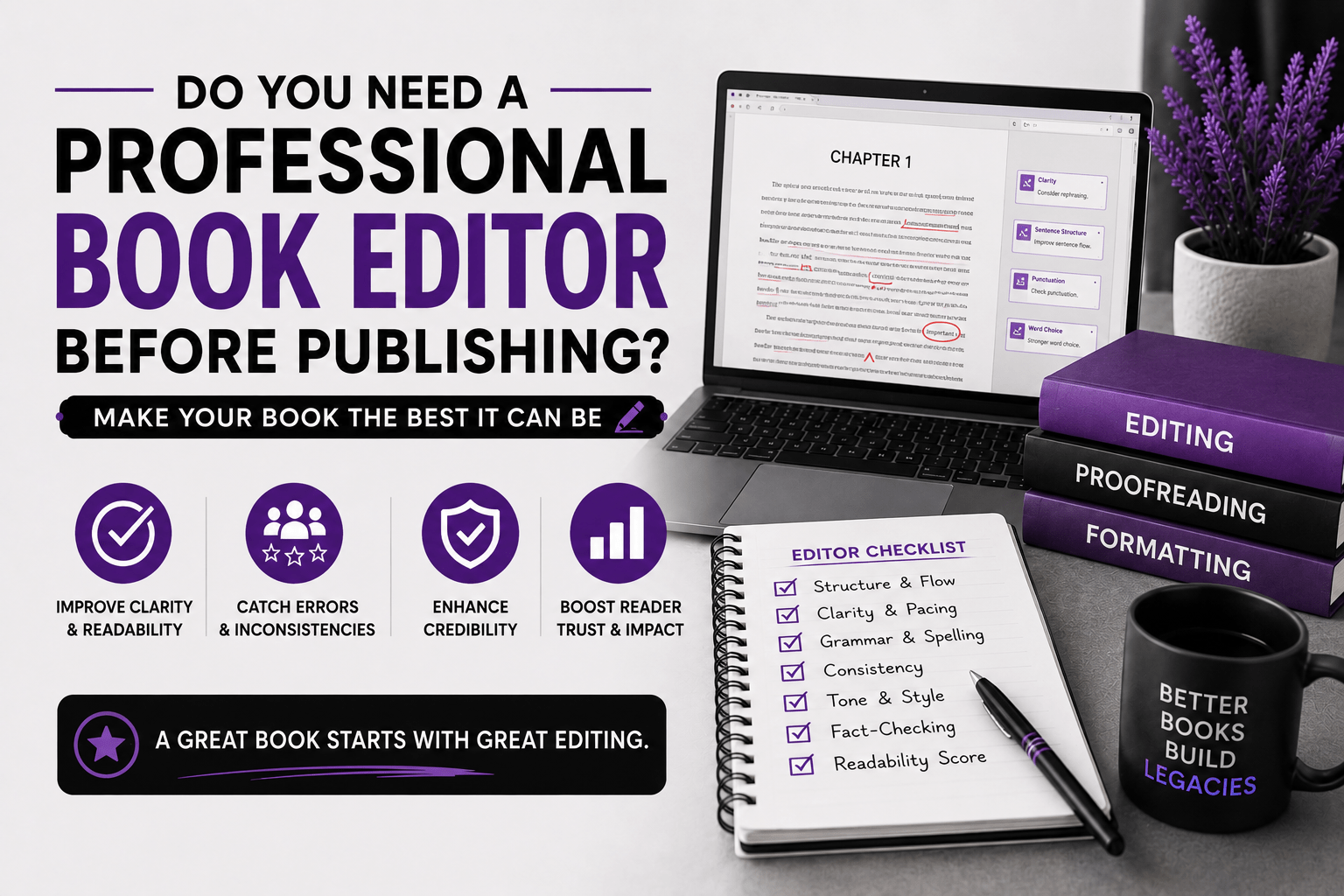
You’ve finished your manuscript. Maybe you’ve read it ten times. Maybe your friends and family already told you it’s ready. So do you really need to pay someone else to edit it before you publish?
Short answer, yes, almost always. But the reason isn’t just about catching typos. A professional book editor changes how your book reads, how readers experience it, and whether it holds up against everything else competing for their attention.
Here’s what a professional book editor actually does, and why skipping this step is one of the most common mistakes new authors make.
Why Self-Editing Only Gets You So Far
You know your story too well to edit it objectively. After months or years with the same manuscript, your brain fills in gaps automatically. You read what you meant to write, not always what’s actually sitting on the page in front of you.
This isn’t a skill problem. It happens to experienced writers too. A professional book editor comes in with fresh eyes and no attachment to your original vision, which means they catch confusing scenes, pacing issues, and plot holes you’ve stopped noticing entirely.
Friends and family aren’t a substitute either. They usually want to encourage you, not critique your structure or point out that chapter six drags. That kind of honest feedback is exactly what a paid editor is there to give you, even when it’s not what you want to hear.
The Different Types of Editing, and Why Order Matters
Editing isn’t one single step. Most manuscripts go through a few distinct rounds, and doing them out of order wastes both time and money.
Developmental editing comes first. This looks at the big picture: structure, pacing, character arcs, and whether your story or argument actually holds together. It’s the most intensive round, and it’s where the biggest changes happen before anything else gets touched.
Line editing comes next, once the structure is solid. This focuses on sentence-level flow, word choice, tone, and rhythm. It’s about making your writing sound like the best version of your own voice, not someone else’s version of it.
Copyediting and proofreading come last. These catch grammar mistakes, punctuation errors, and formatting inconsistencies right before your manuscript goes to print or upload. Skipping straight to this stage without the earlier rounds means you’re polishing a manuscript that might still have deeper problems underneath the surface.
Working with full editing support that covers all these stages in the right order saves you from paying for proofreading twice after a developmental edit ends up reshaping half your chapters anyway.
What Happens When You Skip Professional Editing
Books with weak editing get noticed, and not in a good way. Readers leave reviews mentioning confusing pacing, inconsistent characters, or sentences that just don’t flow. Once a few reviews call out editing issues, it affects how new readers see the entire book, even if the story itself is strong underneath.
Retail platforms and algorithms also factor reviews in when deciding what to recommend. A book with a handful of one-star reviews about editing quality gets buried faster than one with clean, professional execution, regardless of how good the underlying idea actually was.
There’s also a harder cost to swallow. Readers who stop midway through a poorly edited book rarely leave a review at all. They just quietly close it and move on, and you never even know why they left or what pushed them out.
Signs Your Manuscript Needs Professional Editing
A few signs point clearly toward bringing in a professional editor rather than relying on your own read-through. If beta readers give conflicting feedback about pacing or clarity, that’s usually a structural issue an editor can pinpoint quickly. If you’ve reworked the same chapter more than three times without feeling settled, outside eyes will help more than another solo pass ever could.
If this is your first book, professional editing matters even more. You haven’t built the instincts yet for spotting your own patterns, whether that’s overusing certain phrases, rushing endings, or burying key information too deep inside a chapter.
Even experienced authors benefit from a second opinion. Writers who’ve published multiple books still bring in editors, not because their skills declined, but because objectivity on your own work is nearly impossible to fake, no matter how many books you’ve finished before this one.
How to Choose the Right Editor for Your Book
Not every editor fits every project. Genre experience matters a lot here. An editor who’s spent years working on thrillers may not be the right fit for a business memoir, and the same holds true in reverse. Ask for a sample edit on a few pages before committing to a full manuscript, so you can see exactly how they handle your voice.
Also ask what type of edit they’re proposing and why. A good editor explains their approach clearly, tells you what stage your manuscript needs first, and doesn’t push straight to proofreading if your structure still needs real work.
Editing Is an Investment, Not Just a Cost
It’s easy to look at editing as an expense to minimize. But a well-edited book sells better, gets stronger reviews, and holds up against the competition on any given retail page. Combined with strong book writing support from the start, professional editing turns a rough manuscript into something genuinely ready for readers to pick up.
Authors who invest in real editing tend to see it pay off through better reviews, stronger word of mouth, and a launch that actually builds momentum instead of fizzling out in the first week. That momentum matters even more once your marketing plan kicks in, since reviewers and early readers respond better to a manuscript that reads clean from the very first page.
A polished manuscript also makes marketing easier down the line. Reviewers, podcast hosts, and bloggers are far more willing to feature a book that reads professionally, which means editing pays off long after the manuscript itself is finished and out in the world.
How The Apex Publishing Handles Editing
At The Apex Publishing, our editing process covers developmental, line, and copyediting rounds, all handled by editors matched to your genre and goals. We also connect editing directly with self-publishing support, so your manuscript moves smoothly from edits into design and launch without extra delays between teams.
If you’re not sure what stage your manuscript needs, talk to our team and we’ll walk you through the right editing path for your book.